
Citegrade vs AI SEO dashboards: editor vs monitor
Most AI SEO products are dashboards that monitor visibility. Citegrade is a tool that fixes the page. Here's a detailed comparison.
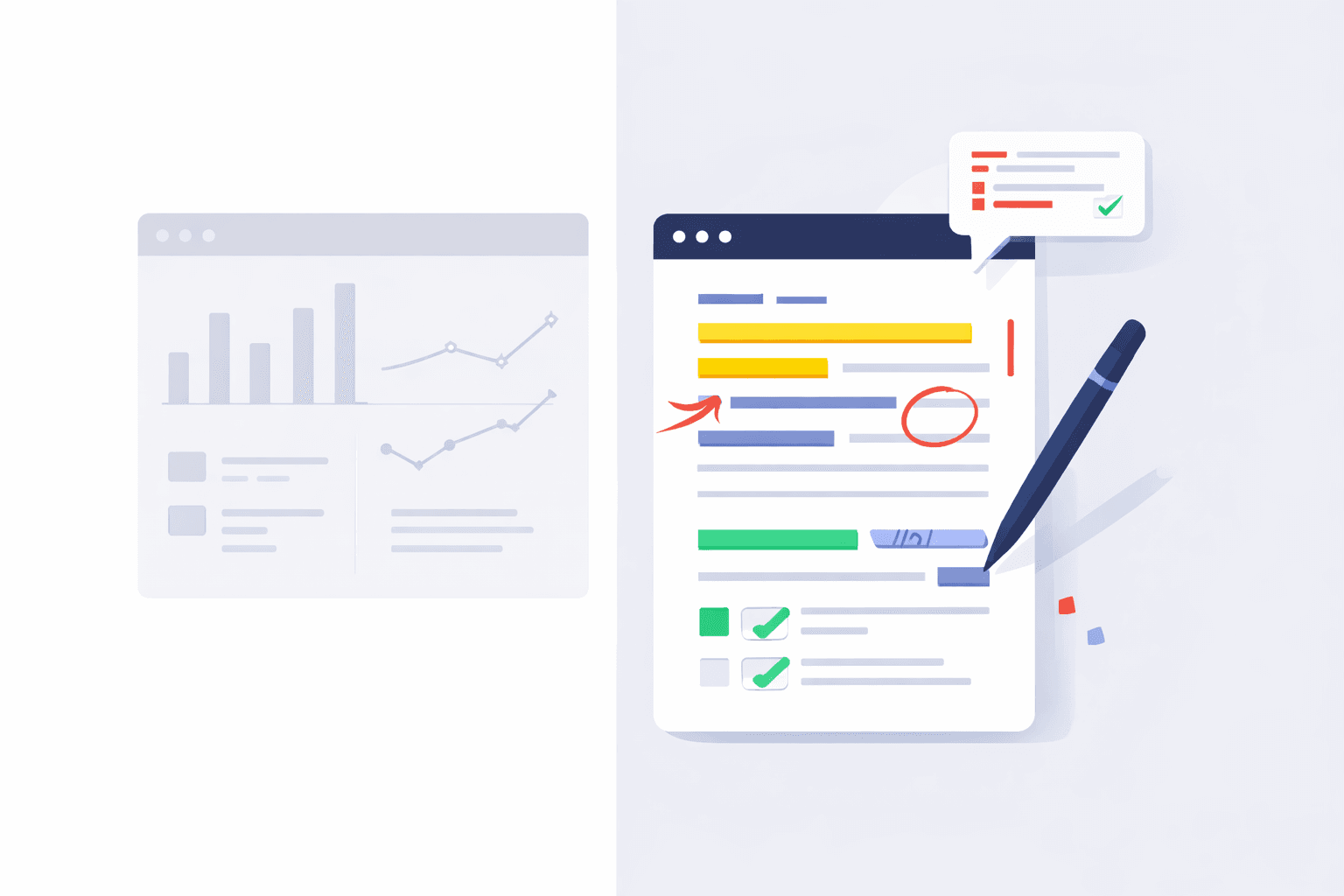
TL;DR: AI SEO dashboards (tools like Otterly.ai, Peec AI, and Scrunch AI) monitor where your brand appears in AI answers. Citegrade opens the actual page, diagnoses paragraph-level citation blockers, and generates rewrites you can apply with one click. Dashboards answer “what's happening.” Citegrade answers “how to fix it.”
A new category of “AI SEO” tools has emerged in the past 18 months. Products like Otterly.ai, Peec AI, Scrunch AI, and others promise to help you track your visibility in AI-generated answers — Perplexity citations, ChatGPT mentions, Gemini references. Search Engine Land has called this the rise of Generative Engine Optimization (GEO).
Most of them do the same thing: show you a dashboard of where your brand appears (or doesn't appear) in AI answers. That information is useful. But it has a fundamental limitation: it tells you that something is wrong without telling you what to change in the actual content.
A monitoring tool that tracks your brand's visibility in AI-generated search answers across LLMs like ChatGPT, Perplexity, and Gemini. Examples include Otterly.ai, Peec AI, and Scrunch AI. These tools show visibility trends, competitor comparisons, and query coverage. They do not modify content.
A tool that scans individual web pages at the paragraph level, identifies structural and semantic citation blockers across 7 dimensions, and generates one-click rewrites that make pages extractable by LLMs. Operates on the page itself, not on visibility metrics.
Full comparison: Citegrade vs. AI SEO dashboards
| Capability | AI SEO Dashboards (Otterly, Peec, Scrunch) | Citegrade |
|---|---|---|
| Primary function | Monitor AI visibility | Fix the content |
| Level of analysis | Domain / page level | Paragraph level |
| Output | Charts, scores, trend lines | Rewritten text, before/after diffs |
| Actionability | Tells you what's wrong | Generates the fix |
| Analysis dimensions | Single visibility score | 7 dimensions (Answer Extractability, Structure, Evidence, Original Information, Quotability, Coverage, Freshness) |
| Content editing | Not available | One-click rewrites with diff |
| Competitor tracking | Yes — who appears in AI answers | No — focused on fixing your page |
| CMS integration | Rarely | Notion, Google Docs, Webflow, WordPress, GitHub |
| Query monitoring | Yes — which queries trigger your brand | No — operates on page content, not queries |
| Time to value | Days (need data to accumulate) | 30 seconds (immediate audit results) |
The dashboard problem in detail
Here's what a typical AI SEO dashboard shows you:
- Your brand was mentioned in 12 AI answers this week (down from 15)
- Competitors X and Y are cited 3x more often than you
- Your visibility score dropped 8 points
- Here are 47 queries where you don't appear
Now what? You know your AI visibility is declining. But the tool doesn't open any of your actual pages. It doesn't tell you which paragraph is blocking citation. It doesn't show you what to rewrite. It's a report, not a solution. As Search Engine Journal argues, monitoring without actionability creates a “so what?” problem for teams.
How Citegrade works differently
1. Paragraph-level analysis
Every paragraph is individually assessed for semantic clarity, entity density, evidence structure, and extractability. Issues are flagged at the exact paragraph where they occur — not at the page or domain level.
| What you see in a dashboard | What you see in Citegrade |
|---|---|
| “Your blog has low AI visibility” | “Paragraph 3 uses vague language — here's a rewrite with specific metrics” |
| “Competitor X is cited more often” | “Your opening lacks entity references — add product name and framework in first 100 words” |
| “Visibility score: 34/100” | “Answer extractability: 78, Structure: 82, Evidence: 64, Original information: 43, Quotability: 59, Coverage: 71, Freshness: 91 — originality is the bottleneck” |
2. Rewrites, not recommendations
Most tools give recommendations: “improve content structure,” “add more specific claims.” These are correct but not actionable. Citegrade generates the actual rewrite for every issue, with a visual before/after diff. For the rewrite patterns we use most, see our practical guide to citation-ready content.
3. Seven diagnostic dimensions
| Dimension | What It Measures | Example Issue |
|---|---|---|
| Answer extractability | Whether content directly answers questions with clear, extractable statements | Page discusses topic broadly but never states a direct answer |
| AI-friendly structure | Heading hierarchy, semantic HTML, section organization | H3 appears before H2, breaking section boundaries |
| Evidence & sources | Data, citations, and verifiable claims backing assertions | Claims made without supporting data or source attribution |
| Original information | First-hand research, original data or expert input rather than synthesis | Every claim is sourced elsewhere, giving an AI no reason to cite this page |
| Specific & quotable | Use of concrete numbers, named entities, and verifiable facts | Vague language like “many companies” instead of specific metrics |
| Topic coverage | Completeness of topic treatment and subtopic inclusion | Key subtopics missing that competitors address |
| Freshness & authority | Whether statistics and references are current, and how credible the author looks | Referenced data is from Q2 2023, 3+ years old |
4. Publishing workflow integration
Citegrade connects directly to the tools teams already use. Import from Notion or Google Docs, apply fixes, push optimized content to Webflow or WordPress, export as markdown to GitHub.
When to use what
| Use case | Best tool | Why |
|---|---|---|
| “Which AI queries mention our brand?” | AI SEO Dashboard (Otterly, Peec) | Designed for query-level monitoring and competitor tracking |
| “Why isn't our blog post being cited?” | Citegrade | Diagnoses paragraph-level issues and generates specific fixes |
| “How does our AI visibility trend over time?” | AI SEO Dashboard | Built for longitudinal tracking and reporting |
| “What do I actually need to change in this page?” | Citegrade | One-click rewrites with before/after diffs |
| “I need to present AI visibility data to leadership” | AI SEO Dashboard | Designed for reporting and executive summaries |
| “I need to fix 40 pages before next quarter” | Citegrade | Prioritized fixes with batch workflow and CMS integration |
The distinction in one sentence: AI SEO dashboards monitor whether your page appears in AI answers; Citegrade diagnoses page-level editorial issues and suggests revisions. See the fictional B2B SaaS workflow for an illustrative way to organize the work without treating hypothetical outcomes as customer results.
Try it yourself
The fastest way to understand the difference is to run an audit on one of your own pages. Paste a URL, see the citation readiness score across all 7 dimensions, review the paragraph-level issues, and apply a rewrite. The entire process takes under 30 seconds.
Frequently asked questions
- Do I need both an AI SEO dashboard and Citegrade?
- Choose based on the next job. Dashboards report where a brand appears; Citegrade identifies page-level editorial issues and suggests revisions. Teams that need both diagnosis and longitudinal monitoring can pair the two categories.
- Which tool is better for startups with limited budget?
- Citegrade. Dashboards show you a problem you can't act on — they deliver charts, not fixes. Citegrade's free plan gives 2 audits per month with rewrites included, so a small team can fix their top 2 pages monthly. Add a dashboard only after you've fixed your top 10-20 pages.
- Can Citegrade track competitor citations the way Otterly or Peec do?
- No. Citegrade is focused on fixing pages, not monitoring visibility. If competitor tracking is a core requirement, pair Citegrade with a dashboard tool. Citegrade does show which competitors are cited instead of you on a given query — but not longitudinal competitor visibility trends.
- How does Citegrade pricing compare to AI SEO dashboards?
- AI SEO dashboards typically start at $100-500/month for small teams and scale to enterprise pricing. Citegrade starts free (2 audits/month) and tops out at $9.99/month for 120 audits. Dashboards monitor; Citegrade modifies. Different price points reflect different scopes of work.
- Which tool should I use if I only have budget for one?
- Pick based on what you need next. If you need to diagnose and revise specific pages, use Citegrade. If you need longitudinal brand-visibility reporting across AI answers, use a monitoring dashboard.